You come home at night, wiped out by a rough day. Your partner asks “how are you?”, you say “yeah, I’m fine”. Not because it’s true, but because the alternative would mean explaining. And explaining, after a day like that, takes energy you don’t have.
Everyone knows that little daily lie. It seems harmless. But stacked over weeks, it creates an invisible distance between people who live together. You share a roof but no longer really share an inner life. It’s often a symptom that mental load has overflowed into the emotional side too.
The shared mood journal (one emoji a day, an optional sentence) is a surprisingly effective fix for that drift. Let’s look at why it works and how to set it up without overthinking it.
Why an emoji is worth a thousand words#
There’s something counterintuitive about expressing a complex emotion through an emoji. Sounds reductive. Actually, it’s the opposite: it’s freeing.
When you have to put words on a state, the mind kicks in. You filter. You justify. You minimize (or dramatize). Picking a state on a scale (🤩 Super · 😊 Cool · 😐 Alright · 🥺 Lame · 😭 Awful) asks the brain to do something different: name without explaining.
This detour through imagery has 3 effects:
- It sidesteps social censorship (“if I say I’m not doing well, they’ll worry”)
- It allows a regularity that’s impossible in narrative mode (a daily emoji is 5 seconds)
- It creates a visual history, which opens conversations you wouldn’t have otherwise
The really powerful bit: the calendar over time#
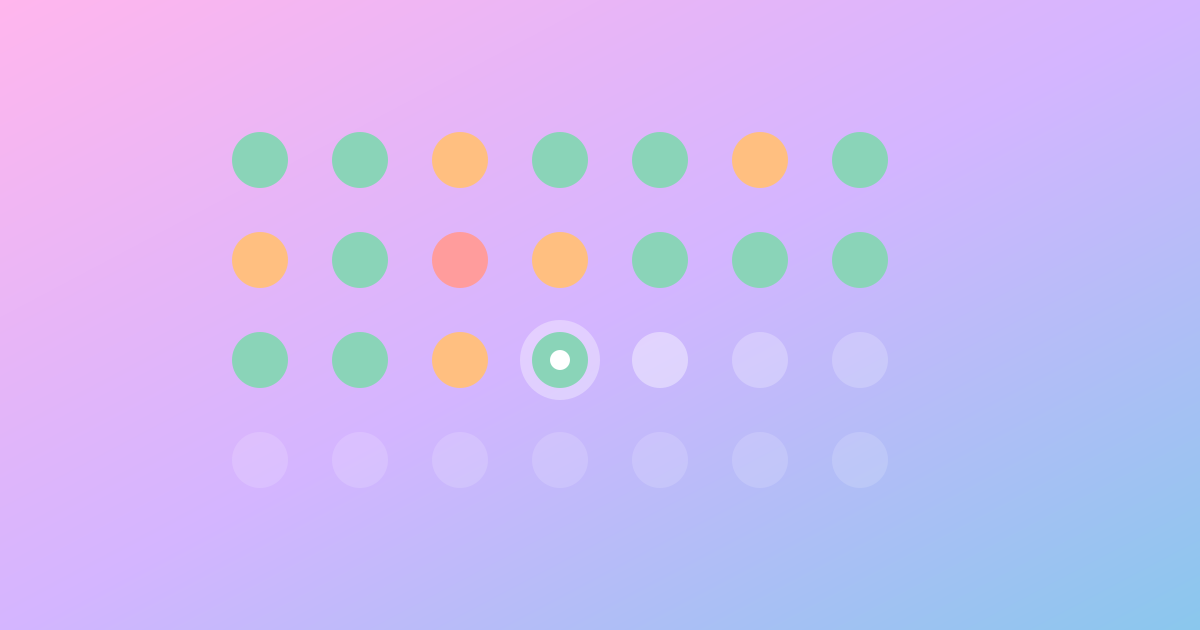
What changes everything isn’t today’s emoji. It’s accumulation across weeks. When you look at your month and each day has taken the color of your mood (green = good, yellow = meh, red = tough), patterns emerge you didn’t suspect:
- “Huh, I had 5 red days in a row in early March, that was the deadline period”
- “My Mondays are systematically yellow”
- “Since we changed our Sunday evening rhythm, Mondays are better”
These correlations don’t come out of raw memory. Humans forget their recent emotional states fast. A visual journal makes them undeniable.
And when the journal is shared in a household, conversation changes: “I can see you had a hard week, want to talk about it, or not?” becomes possible. Before the journal, it stays stuck in the back of someone’s head.
The golden rule: don’t force anyone to explain#
Crucial point: a family mood journal should never force total transparency. That would be counterproductive. The point is the opposite: offer a light signal that others can see without anyone having to explain anything.
Concretely: you can have a red day without telling the story. The emoji alone opens the door to “I see, want to talk about it or not?” which respects the other person’s space, without forcing.
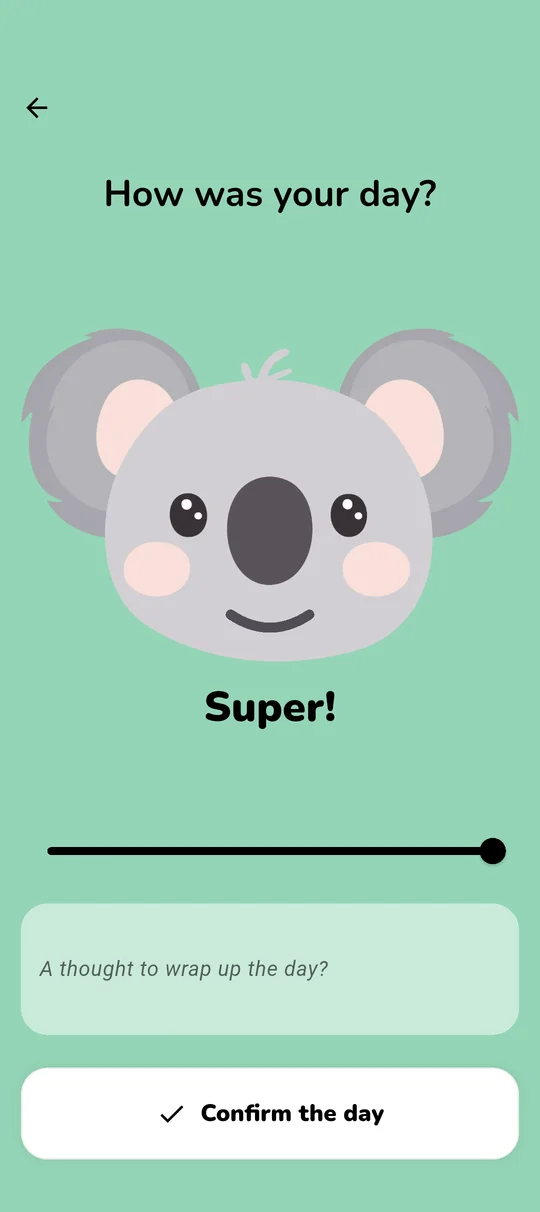
In Koabit, you log your mood on a scale with the Koala mascot that shifts expression (from sad to great) and you can add an optional short note to close out your day. Values logged by each household member feed a colored monthly calendar you can view as a household average or per person, which reveals patterns over time.
How to start: 3 keys to a journal that lasts#
Most journaling attempts (mood, gratitude, bullet journal…) die within 3 weeks. To dodge that, three principles:
1. A fixed moment. Attaching the journal to an existing ritual means you don’t have to think about it. The two moments that work best:
- Morning, at wake-up (before coffee): you log how you feel a priori
- Evening after dinner: you close out the day
Both work. But you have to pick one and stick with it. Alternating is sabotaging.
2. Five seconds, no more. Classic trap: turning the ritual into a long introspective exercise. Within a week, abandoned. The goal is the opposite: the ritual should be so short it doesn’t feel imposing. An emoji, sometimes a sentence. That’s it.
3. No audit. If one household member starts questioning the others about past moods, the journal dies. The info is available: it opens a conversation if the person wants to. It’s never used as a reproach.
For kids too#
Often-underrated use: kids (from age 7-8) love this kind of ritual. For them it’s almost a game. And it teaches them, early, to name their emotions, a rare and precious skill.
In a family, the journal becomes a soft communication channel: a kid who has trouble saying “my school day was lousy” can pick 😢 at night. The parent notices, and can open the conversation on their own terms, without interrogating.
What about streaks?#
Some apps gamify the ritual through streaks, consecutive days where you’ve logged your mood, with a growing 🔥 flame. It’s double-edged:
- Positive: it helps install the habit over the first 3-4 weeks (peak adherence window)
- Negative: once the streak breaks, some users quit in frustration
The right dose: make streaks a bonus, not a goal. The point isn’t “succeeding” at the ritual, it’s understanding yourself better.
After 3 months#
What happens once the ritual is well-installed often exceeds initial expectations:
- You know your cycles (tougher weeks, seasons)
- You anticipate your needs better (sleep, solitude, activity)
- Loved ones read your state more finely
- Hard conversations start more easily
It’s not a therapeutic tool. But it’s a through-line in household daily life, creating a form of mutual attention without forcing the conversation.
This article is part of The complete guide to shared living, which also covers household chores, shared expenses, AI receipt scanning and mental load.
Want to try this ritual at home? Koabit includes a shared mood journal (Koala that shifts expression + optional note), a monthly view where each day takes the color of your mood, optional streaks, plus everything else for shared living (tasks, expenses, calendar). Free, no ads, no subs, on iOS and Android. 30 seconds to install, 5 seconds a day after. The kind of habit that changes a household’s vibe in 2 months.