
Living with roommates is often the sweet spot between independence and not being broke. But the moment you have to settle rent, the shared groceries, or Friday night’s dinner bill, you can feel the tension building up. And it’s not a detail: splitting expenses is the #1 source of conflict in shared housing, way ahead of cleaning.
Good news: there aren’t 15 options. There are 4. And knowing which one to use when is 90% of the job.
Method 1: Equal shares (the default that mostly works)#
Simplest one: divide the total by the number of people. 90 € of groceries for 3? 30 € each. Done.
Use it without thinking for:
- Rent, if the rooms are roughly the same
- Shared groceries (toilet paper, dish soap, oil, coffee)
- Shared subs (internet, Netflix, flat-rate electricity)
Upside: zero math, zero debate. Downside: the second situations diverge (income, usage, room size), it gets unfair. Move to the next method.
Method 2: Pro-rated by income#
When incomes are very different, fairness isn’t strict equality, it’s proportionality. Picture this: a student and a professional sharing a flat, 1,200 € rent. At 50/50, the student forks over 40% of their salary, the pro pays 15%. Not sustainable.
The formula: each person pays a percentage equal to their share of total income. A earns 1,500 € and B earns 3,500 €? Total 5,000 €, so A pays 30% and B pays 70%.
Prerequisite: talk about money openly. Lots of roommates dodge the conversation out of politeness and end up stewing in resentment for 2 years. Put the numbers on the table at move-in, you dodge 95% of future drama.
Method 3: Weighted shares (for the tricky cases)#
Sometimes the inequality isn’t financial, it’s structural: you have the biggest room, someone else has the private bathroom, the third shares their room with a partner. Equal shares? Nope. Income-based? Doesn’t fit either.
The fix: give each person a number of shares that matches what they actually consume. 3-person example:
- A (small room, shared bathroom): 1 share
- B (big room, shared bathroom): 1.5 shares
- C (big room + private bathroom): 2 shares
Total 4.5 shares. On 1,800 € rent: A pays 400 €, B 600 €, C 800 €. Clean.
This is the most refined method for rent. Bit of discussion up front, but then it’s stable for years.
Method 4: Fixed amounts per person#
Classic case: the restaurant bill. You had the 25 € menu, your roommate had a 12 € salad. Split 50/50? Not great. Or groceries where each has their own stuff (diets, preferences, allergies).
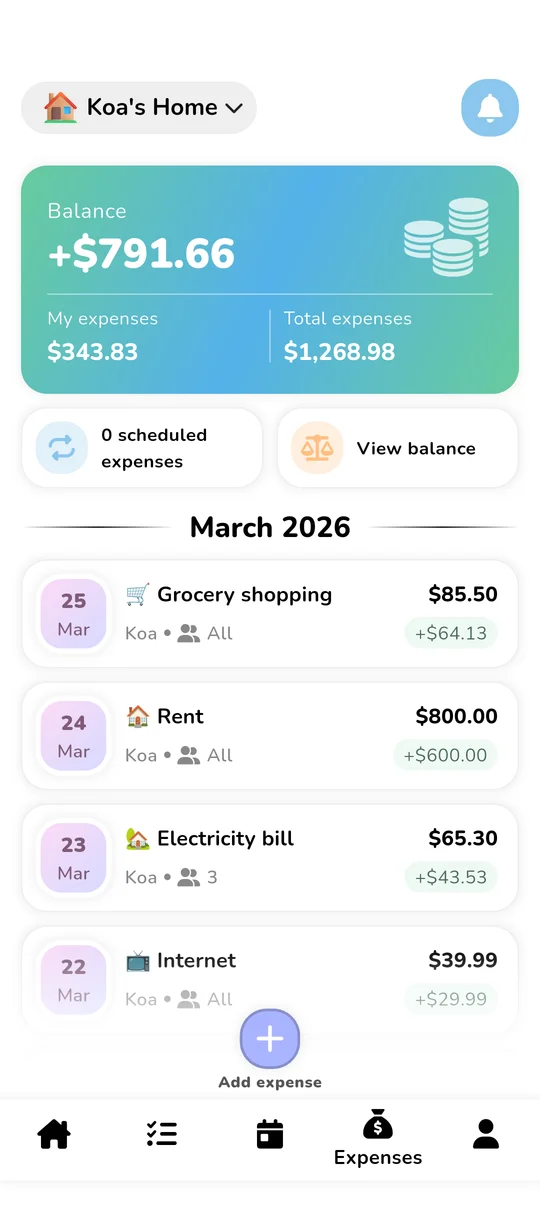
Here, each person pays back exactly what they consumed. Best setup is a tool that scans the receipt and assigns each line. That’s exactly why we built an AI receipt scan into Koabit, the mobile app we’re developing for shared living (tasks, expenses, calendar, mood, all in one place): each receipt item becomes a sub-expense you can assign to the right person.
Fixes the micro-injustices that slowly wreck the vibe: “I always pay for the wine”, “I don’t eat meat but I’m paying for the roast”. Gone.
The 3 golden rules of zen roommate life#
Beyond the method itself, three habits change everything:
1. Log it right away. An expense “to log later” is a forgotten expense. An app that takes 10 seconds to open is the only thing that works long-term.
2. Settle every month. Letting balances pile up for 6 months means ending up with a 400 € reimbursement that hurts. Monthly is psychologically manageable.
3. Accept occasional asymmetry. One month someone drops 200 € extra on groceries, the other covers the electricity bill next month. Balance happens over time, not on every transaction. Counting every cent is exhausting and poisons the vibe.
Spreadsheet or app?#
Historically roommates handled this in a Google Sheet. It works, but you have to enter each line, recompute balances, remember who owes whom. It’s a chore.
Dedicated apps (Koabit, Splitwise, Tricount…) automate everything. Koabit goes one step further: it also handles tasks, calendar and the household’s mood journal, not just expenses. Either way, the tool gives you:
- 3-second entry
- Auto-calculated balances
- Optimized reimbursements (instead of 6 transfers, often 2 do the job)
- Currency conversion (handy for international roommates)
- Full history
The real win isn’t doing the math, it’s not thinking about it. The app tracks, you focus on actually living together.
This article is part of The complete guide to shared living, which also covers household chores, AI receipt scanning, mental load and the mood journal.
If you share expenses with roommates, a partner or family, Koabit is built for exactly that. The 4 splitting modes from this article, AI receipt scanning, auto-balanced settlements and real-time sync: all in there. Free, no ads, no subs, on iOS and Android. Create your household, invite your people, forget Google Sheets forever. 30 seconds to install.